![MonitorControl vs DisplayBuddy: The Ultimate Comparison for Mac Users [2026]](/blog/displaybuddy_vs_monitorcontrol.jpeg)
MonitorControl vs DisplayBuddy: The Ultimate Comparison for Mac Users [2026]
MonitorControl is the most popular free Mac monitor app. Here's how it compares to DisplayBuddy and which one is right for your setup.
MonitorControl is one of the most popular free Mac apps on GitHub, and for good reason. It does what it says: control your external monitor brightness and volume from the menu bar without touching the buttons on your display.
But for Mac users managing multiple monitors daily, MonitorControl runs out of steam fast. Here is the short version:
MonitorControl is a free, open-source utility focused on basic DDC brightness and volume control. It gets the job done for single-monitor setups with compatible hardware.
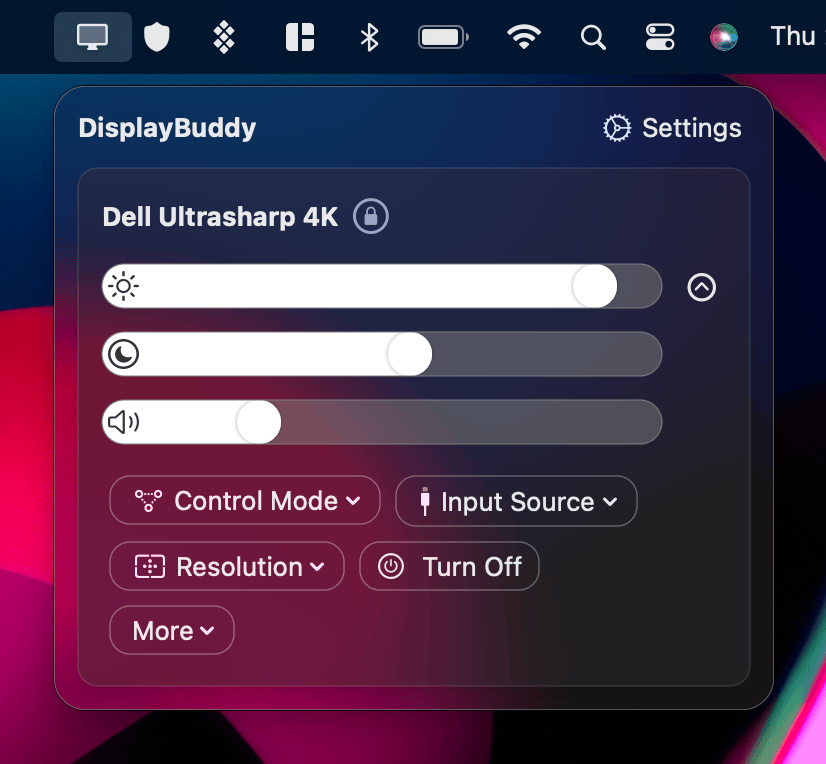
DisplayBuddy is a full-featured display management app for Mac and Windows. Its strengths are multi-monitor Presets, automated Schedules, Sync, Samsung & LG Smart Monitor support, and a polished native macOS interface.
Here's what the two apps actually look like side by side:
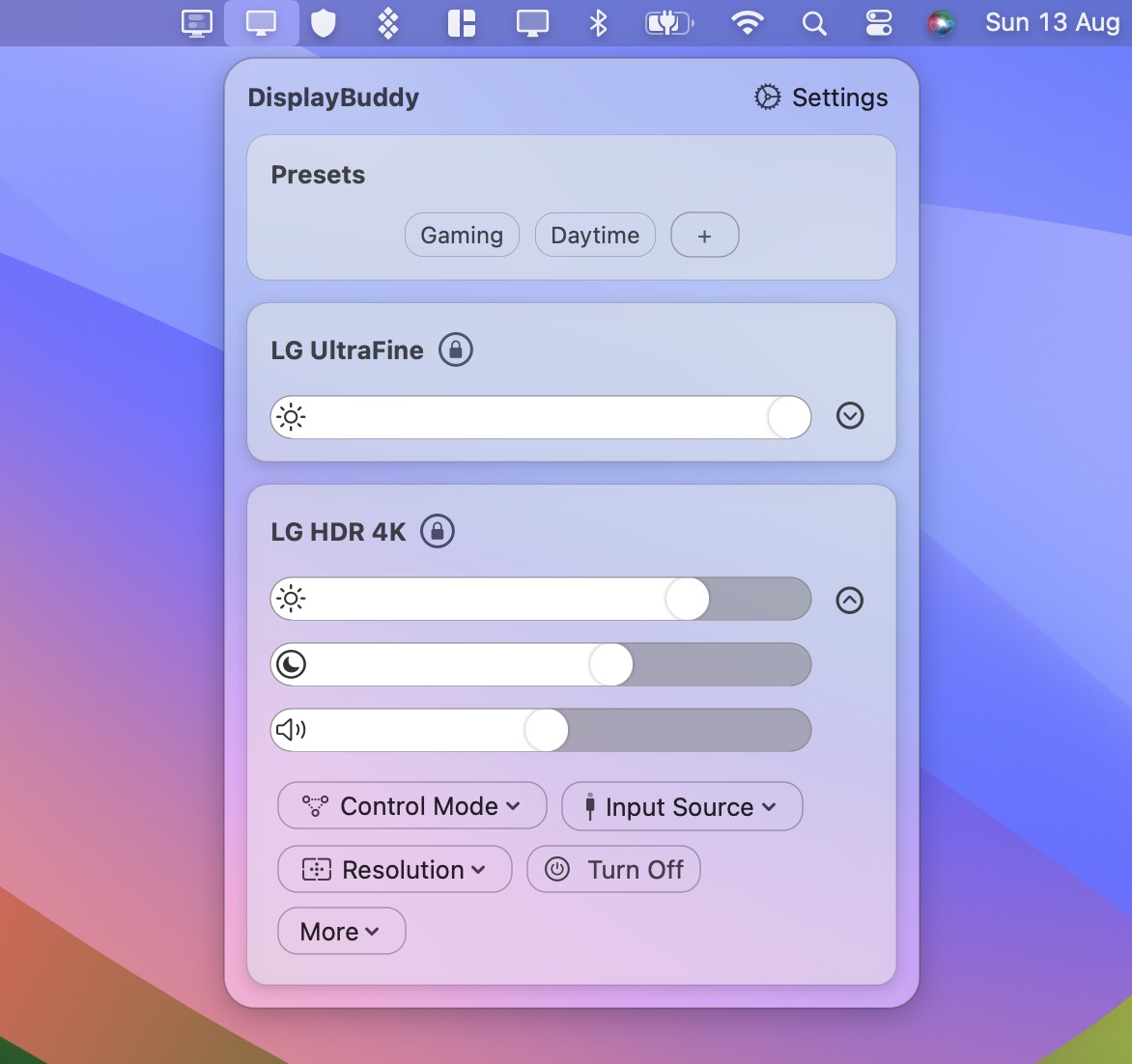
For most Mac users, DisplayBuddy is the better choice. Here is the full breakdown.
MonitorControl vs DisplayBuddy: Feature Comparison
| Feature | DisplayBuddy | MonitorControl |
|---|---|---|
| Brightness control (DDC) | ✅ Yes | ✅ Yes |
| Contrast control | ✅ Yes | ✅ Yes |
| Volume control | ✅ Yes | ⚠️ Limited (see below) |
| Keyboard brightness keys | ✅ Yes | ✅ Yes |
| Apple Shortcuts support | ✅ Yes | ✅ Yes |
| Input source control | ✅ Yes | ❌ No |
| Presets (save and restore all display settings) | ✅ Yes | ❌ No |
| Save display layout and monitor arrangement | ✅ Yes | ❌ No |
| Sync brightness across all monitors | ✅ Yes | ⚠️ Basic |
| Schedules (automate settings by time or event) | ✅ Yes | ❌ No |
| Siri integration | ✅ Yes | ❌ No |
| macOS widgets | ✅ Yes | ❌ No |
| Spotlight integration | ✅ Yes | ❌ No |
| Samsung Smart Monitor control (M5, M7, M8, S9) | ✅ Yes | ❌ No |
| Native macOS UI | ✅ Yes | ✅ Simple |
| Apple Silicon native | ✅ Yes | ✅ Yes |
| Mac App Store version | ❌ No | ⚠️ Lite only (no DDC) |
| Install via Homebrew | ❌ No | ✅ Yes |
| Windows version | ✅ Yes | ❌ No |
| Professional support | ✅ Yes | ❌ Community only |
| Price | From $18.99 (one-time) | Free |
| Free trial / guarantee | 7-day free trial (Windows), 7-day money-back (Mac) | N/A |
Why Mac Users Choose DisplayBuddy Over MonitorControl
Presets: Save Everything, Switch in One Click
Presets are DisplayBuddy's most-used feature, and MonitorControl has nothing like them.
With DisplayBuddy Presets, you can:
- Save brightness, contrast, volume, input source, display layout, and resolution as a named Preset across every connected monitor
- Switch between setups like "Work Mode," "Gaming Mode," or "Evening Mode" with a single click or a Siri command
- Apply changes across all monitors simultaneously, with no per-screen adjustments
- Trigger Presets through Siri, Apple Shortcuts, Control Center widgets, or Spotlight
MonitorControl stores no display configurations. Every time your work context changes, you are starting over manually.
Sync: One Adjustment, All Monitors
Both apps offer brightness sync, but they work differently. MonitorControl can mirror your built-in screen's brightness changes to external displays and offers a unified slider to adjust all monitors together. DisplayBuddy's Sync goes further:
- Adjust any one monitor and all others follow automatically
- Works from the app, keyboard shortcuts, or Siri voice commands
- Runs silently in the background with no manual management
- Ties directly into Presets and Schedules, so synced settings carry across automated workflows
MonitorControl's sync covers the basics. DisplayBuddy's Sync integrates with Siri, Presets, and Schedules in a way MonitorControl cannot match.
Schedules: Your Displays Adapt Automatically
DisplayBuddy Schedules let your display settings change on their own based on triggers you set once:
- Time of day (for example, dim all monitors at 9 PM)
- Sunrise and sunset
- Mac lock and unlock
- Dark Mode toggle
- Monitor connected or disconnected
- Charging state (separate settings for battery vs plugged in)
MonitorControl has no Schedules feature. Every adjustment is manual.
Samsung Smart Monitor Support
DisplayBuddy includes built-in support for Samsung & LG Smart Monitors over Wi-Fi, including full control of brightness, contrast, volume, and input source. MonitorControl does not support Samsung Smart Monitors.
Professional Support and Regular Updates
MonitorControl is open-source software maintained by contributors and volunteers. The project receives updates infrequently, and when macOS releases break things, fixes depend on community bandwidth. When macOS Sequoia shipped, MonitorControl crashed on launch, and users had to wait weeks for a compatibility fix.
DisplayBuddy ships two to three updates per month and has dedicated developer support. When something breaks on a new macOS version, it gets fixed quickly.
What Is MonitorControl?
MonitorControl is a free, open-source app for controlling external monitor brightness, contrast, and volume on macOS. It works by sending DDC/CI commands over your display cable, which tells the monitor to adjust its actual hardware backlight, just like pressing the physical buttons would.
MonitorControl is available in two versions:
- MonitorControl (full version): Available on GitHub and via Homebrew. Supports DDC hardware control for brightness, contrast, and volume. This is the version most Mac users mean when they say "MonitorControl."
- MonitorControl Lite: The Mac App Store version. Uses software-based dimming only, with no DDC hardware control. Because the App Store restricts low-level hardware access, MonitorControl Lite cannot actually change your monitor's backlight. It only adjusts how macOS renders the image on screen.
If you are installing MonitorControl for the first time, use the GitHub version or Homebrew, not MonitorControl Lite. MonitorControl Lite is the version many people accidentally install first, only to find it cannot actually control their monitor's hardware. The Mac community consistently describes it as the significantly limited version.
MonitorControl supports:
- DDC/CI for hardware brightness, contrast, and volume on compatible monitors
- Native Apple protocol for Apple displays and built-in screens
- Gamma table control for software dimming on displays that do not support DDC
- Shade (overlay) control for AirPlay, Sidecar, and DisplayLink screens
- Smooth brightness transitions
- Native macOS OSD (on-screen display) for brightness and volume changes
The app has over 32,000 stars on GitHub, making it one of the most-watched display utility projects for macOS.
How to Download MonitorControl
MonitorControl is available from three places:
- GitHub: Download the latest release from github.com/MonitorControl/MonitorControl
- Homebrew: Run
brew install --cask monitorcontrolin Terminal - Mac App Store: Search for "MonitorControl Lite" (software dimming only, no DDC hardware control)
Important note: MonitorControl requires v4.3.3 or newer for macOS Sequoia and Tahoe compatibility. Earlier versions crash on launch. If you are on an older version, download the latest release manually from GitHub.
Consider DisplayBuddy if you need more than basic brightness control: a 7-day free trial is available on Windows, and a 7-day money-back guarantee applies on Mac.
Common Problems with MonitorControl on Mac
Volume Control Frequently Does Not Work
This is the most common complaint about MonitorControl, and it affects a wide range of Mac and monitor combinations.
MonitorControl relies entirely on DDC hardware commands for volume control. It has no software volume fallback. If your hardware combination does not support DDC volume, the volume slider appears in the interface but does nothing.
Confirmed cases where volume control does not work in MonitorControl:
- Any Mac connected to a monitor via the built-in HDMI port on M1 Macs (MacBook Pro 14-inch and 16-inch, Mac mini, Mac Studio)
- The built-in HDMI port on the 2018 Intel Mac mini and the entry-level M2 Mac mini
- DisplayLink docks and dongles (DDC is not supported over DisplayLink on Mac at all)
- Many HDMI connections on M-series Macs more generally, where DDC commands for volume are silently dropped
Volume control issues have been reported across dozens of GitHub threads and remain open in the current version. For some users, brightness works but volume does not. For others, the volume slider shows movement but the monitor's actual audio level never changes.
Brightness OSD Broken on macOS Tahoe
On macOS Tahoe, MonitorControl's on-screen brightness indicator no longer reflects the actual brightness value when you adjust an external monitor. The OSD appears, but the percentage shown stays empty or does not update.
This is a known issue as of the current version, confirmed on the MonitorControl GitHub. The developer's own response: "I recommend trying BetterDisplay for now, as it has a proper OSD solution for Tahoe." The OSD issue has no fix planned for the current version.
Sequoia Compatibility Required a Manual Update
When macOS Sequoia shipped, MonitorControl crashed on launch. The fix arrived in v4.3.2 several weeks later, but users had to find and download it manually from GitHub. For a utility that runs silently in the background and is expected to just work, requiring users to monitor GitHub for compatibility fixes is a significant friction point.
A Single Developer Keeping the Project Alive
MonitorControl's recent maintenance has been driven almost entirely by one developer, the same person who builds BetterDisplay. He took over active development to push through Sequoia compatibility, but has been clear that MonitorControl is secondary to BetterDisplay and is working on a full replacement whose timeline is uncertain.
The v4.3.2 release notes include the line "For more features and better compatibility with Sequoia consider switching to BetterDisplay." The project README also directs users to BetterDisplay for advanced features. That is not typical language from a project with confident long-term momentum.
Frequently Asked Questions
Is MonitorControl safe to use?
What is the difference between MonitorControl and MonitorControl Lite?
How do I install MonitorControl on Mac?
brew install --cask monitorcontrol. MonitorControl Lite is available on the Mac App Store but only offers software dimming. DisplayBuddy is a comprehensive alternative to MonitorControl with a 7-day money-back guarantee on Mac.
Why is MonitorControl volume control not working?
What is the best MonitorControl alternative for Mac?
Does MonitorControl work on macOS Tahoe?
Does MonitorControl work on Windows?
Is DisplayBuddy worth it?
What is the DisplayBuddy app on Mac?
What is the best app to control a monitor on Mac?
The Verdict: MonitorControl vs DisplayBuddy
MonitorControl is a legitimate free tool for a specific situation: a single external monitor, a compatible USB-C or DisplayPort connection, and no need for Presets or Schedules. In that narrow scenario, it works well and the price is right.
For anyone managing multiple monitors, working across different setups throughout the day, or relying on a Mac connected via HDMI, MonitorControl runs into limits quickly. Volume control is unreliable on many hardware combinations, the Tahoe OSD is broken with no fix in the current version, and the project's long-term direction is uncertain.
DisplayBuddy covers everything MonitorControl does and adds the features that matter for daily multi-monitor use: Presets to save complete configurations, Schedules to automate settings automatically, deeper Sync with Siri and automation support, Samsung & LG Smart Monitor Wi-Fi support, and a native macOS interface that feels like it belongs on your Mac. DisplayBuddy also works on Windows, where MonitorControl has no presence at all.
Consider MonitorControl only if your setup is a single monitor on a USB-C or DisplayPort connection, you have no need for Presets, Schedules, or automation, and free and open-source is a firm requirement for your workflow.
For everyone else, DisplayBuddy is the better Mac monitor app. It is a one-time purchase with lifetime updates, a 7-day free trial on Windows, and a 7-day money-back guarantee on Mac.
Compare DisplayBuddy With Other Apps
Related guide: How to control external monitor brightness on Mac
DisplayBuddy
for macOS 10.13+
Take control of your monitors
Control brightness, contrast, volume, and much more.
Buy NowLifetime license • 7-day refund on full-price purchases